
22 May 2026
By John Normand, Head of Investment Strategy
AI is the latest iteration in 300 years of innovation waves that have transformed economies and markets. Historically, exposure to these waves has tended to be a profitable investment strategy in the early-to-mid cycle phases, and less so in the later phases. This article – analysing a range of key indicators to assess the maturity and sustainability of the AI wave – discusses how AustralianSuper is approaching AI as an investment theme.
Twelve months ago, debate centred on whether the rapid appreciation in AI valuations and significant flow of capex constituted a bubble, fit to burst. Today, Tech earnings have largely continued to accelerate and beat expectations, which allays for now some concerns that AI optimism is excessive.
Measuring the maturity of an innovation arc
Since ChatGPT’s launch in late 2022, AI has been the dominant theme for global investors. Geopolitical shocks such as Liberation Day and war in the Middle East have sometimes obscured AI’s arc, but behind some short-lived bouts of volatility, no issue has so broadly influenced economies and financial markets as the disruption and transformation that AI is ushering in.
On every indicator, this innovation boom has matured rapidly over the past three and a half years. Our view is that it has further to run. Our assessment draws on a refresh of a dozen key indicators across seven categories that track common features of innovation waves, including adoption curves, capex, productivity, earnings, valuations, capital markets activity, and monetary policy. Data limitations prevent benchmarking AI comprehensively against other transformational booms – the Industrial Revolution, electrification, mass production, computing/Internet, smartphone/cloud – and so caution against strong conclusions based on thresholds for these indicators alone. Instead, we take a balance-of-risk view that also considers trends in macroeconomic and public policy.
In late 2025, at the three-year anniversary of ChatGPT’s launch, three of the seven categories – valuations, capex intensity, and leverage in the Technology, Media and Telecommunications (TMT) sector – appeared further along the maturity curve and potentially frothy, while four – AI adoption, productivity, earnings and monetary policy – appeared early-to-mid-stage. Since then, valuations have improved via a 20% fall in Tech multiples, which leaves the overall array more balanced and the AI arc appearing more sustainable.
Trends in capex intensity and leverage continue to show signs that may indicate an imbalance, however multiples have compressed over the past twelve months to better align with these risks. The current US earnings season has also been robust, with the bulk of Tech companies outperforming expectations and posting strong year-on-year earnings growth. The extent of this outperformance indicates that while investor sentiment is positive, it isn’t overly optimistic.
The AI boom and super
-
Show transcript
Today I have the pleasure of speaking to our Head of Investment Strategy, John Normand, about all things AI and how we're thinking about it from an investment perspective.
Hi John, lovely to speak to you today on all things AI. It now represents a significant share of global listed equity markets. You’ve been doing a lot of research on the topic. Can you talk a little bit about your investment framework and how you approached the research process?
I set out a framework which I guess you could summarise as cycle analysis, recognising that AI is the latest innovation wave. Every innovation cycle has its life span to it, and if we can track these various indicators across the economy, across the equity sectors, across valuations, across leverage, we can come to some judgment as to whether or not the balance of these suggest that this cycle has many years to go in it, or whether it's much more mature and might end sooner.
Even though every innovation is different from the one before, from the previous decade, there are these common features across these different categories of indicators, and we can score these and we can come up with a balance of risk around them, and we can align the portfolio with where we think the balance of risk is and where we think it's going to head over the next year or two.
The question on everyone’s minds is where we are in the AI cycle, and I think your work touches to the AI arc?
So whether we're early, mid or late depends on the specific indicator. If I looked across a whole suite of them, maybe 10 or 12, I'd say we’re mid. So the ones that I think are quite encouraging because they look a little more early stage is adoption, and there are different surveys that measure this, but probably one of the best ones is produced by the US Census Bureau, and the message from that survey is, yes, it's been heavily adopted by corporates in the technology space. It hasn't been heavily adopted by corporates broadly in the US. That gives us some expectation that the diffusion process still has quite a bit to go. That's really encouraging.
Another indicator, which is still a bit early stage is the productivity improvement. Yes, there's measurable improvement in productivity amongst technology companies, but not so much in the economy broadly. That's also hopeful for thinking that the big economic gains are still to come.
Some of these indicators which are looking a little more late-cycle are around capex. Companies are spending extraordinary amounts of capex relative to their sales, and that dynamic, which we call capex intensity, is at levels that we saw in the TMT bubble in the late 1990s. So that's a little bit worrisome, but also, importantly, there's no indication that this AI boom is leading to overvaluation in the markets as a whole.
I think if you looked across the sweep of things, you would say this is probably a middle-aged investment dynamic, and therefore it's still an important anchor for how we position.
Thinking about some of the metrics you do track, are there any that have significantly changed over the last twelve months?
Earnings have been fairly consistently strong, and that's important. So despite all of the shocks that we've seen in the broader economy, some of which are geopolitical, it's pretty obvious from the earnings delivery that this theme maintains a lot of robustness and it's not so vulnerable, I guess, to some of these macroeconomic shocks.
The one that has been a little more worrisome is on the leverage side, and the degree of leverage that's being used varies quite considerably depending on whether we're talking about large, very cash-rich companies like hyperscalers, or smaller kind of second tier, newer entrants into the economy. That's an important distinction, because if the vulnerable companies tend to be on the mid-to-smaller size, it makes us slightly more comfortable with the dynamic in credit markets. But when I look at the sweep of indicators, when I look at the breadth of them across the whole economy, I'm still comfortable with the idea that this is a sustainable investment dynamic.
Are there any other particular risks that you’d be concerned about or any that you’re tracking as a part of the process?
More recently, the concern has shifted towards scarcity on the semiconductor side, and that scarcity is leading to moves in share prices for some of these producers which is pretty extraordinary. And this is having big impacts on an industry level. It's having a big impact in smaller equity markets like some in Asia.
That's just a reminder that there are bottlenecks in different areas and the bottleneck that many people have been focused on a year ago, which is in electricity, is not the bottleneck now. It's in semis. And so if you ask what my biggest concern is, it would be that these bottlenecks become an impediment to the profitability of AI. And when you think about how central banks respond to bottlenecks that create price pressures, they respond by tightening policy. So there are ways in which bottlenecks create price pressures, price pressures create a central bank response, the central bank response creates an interest rate dynamic which is unhelpful to the AI thematic. There's no innovation cycle which exists in a macro vacuum.
And so based on your framework today and weighing up all of the drivers and all of the risks, do you think it’s a bubble?
No, I don't think it's a bubble by any standard metric applied at the broad asset-class level. We're not so concerned about individual share prices, we're concerned about problems at the asset class level, and we don't see those yet. And I think it would take a reasonable passage of time for those sorts of problems to materialise on the leverage front or potentially on the valuation front.
It doesn't mean we haven't adjusted the portfolio in important ways. You can reach a judgment that AI is not a bubble, but still decide to risk manage the portfolio in a more conservative fashion because of the way some other indicators are moving. We wanted to diversify a bit more into non-US markets and non-tech sectors. So you don't need to be a buyer of the bubble view to be a good risk manager. I think there are ways that you can just look at some of the underlying indicators and adjust the portfolio in a way which is mindful of that without having to take a very extreme view that the market is in a bubble.
Thank you so much, John, for your time today. I’m sure members will have found that very valuable. I certainly did. Thank you.
End transcript
Tracking the AI metrics
Below are details of the indicators we’ve examined, with accompanying charts.
-
1. Adoption curve
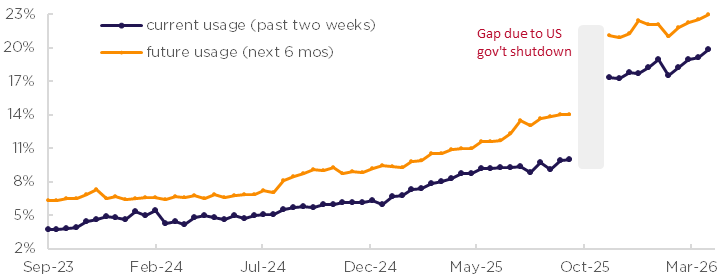
Adoption curve (chart A): Years required for households and/or corporates to reach 50% usage.
The US Census Bureau’s fortnightly Business Trends and Outlook Survey indicates about 20% of US firms use AI currently and 23% intend to in the next six months. Adoption is increasing steadily but remains below 50%, which suggests scope for demand improvement.
Chart A
Adoption curve – US businesses’ AI uptake increasing steadily, but well below 50%Share of businesses using AI in any function (changed in Dec 2025 from “using AI in producing goods and services.”)
Source: AustralianSuper Investment Strategy, US Census Bureau
-
2. Capex growth
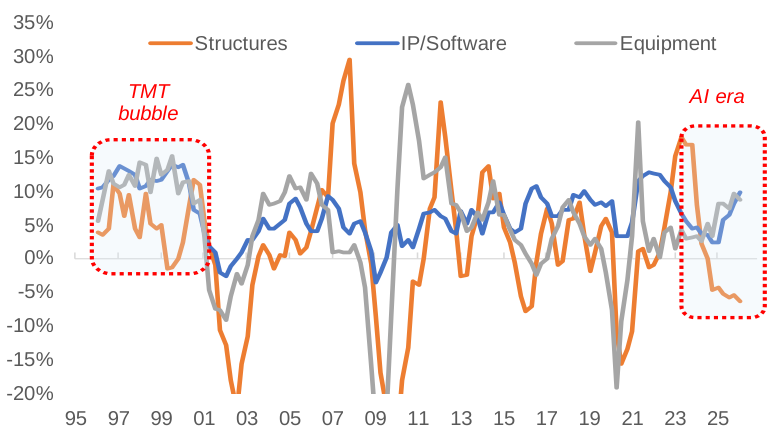
Capex growth (charts B and C): an acceleration as businesses upgrade structures, equipment, and IP/software.
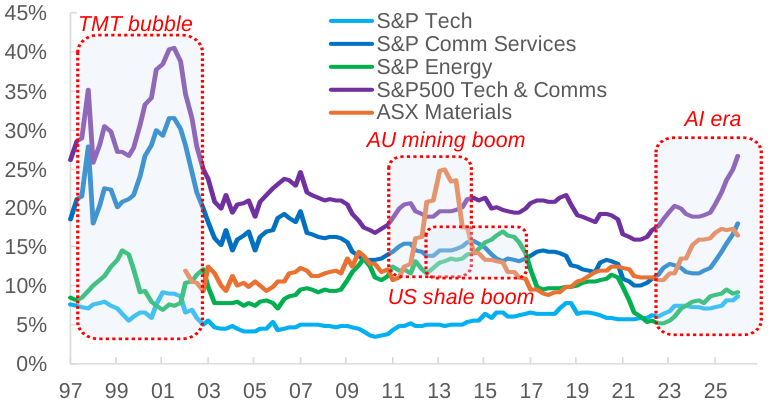
Mega-cap Tech companies are transitioning rapidly from asset-light to asset-intensive business, such that their aggregate capex/sales ratio has risen to almost 30% (chart B). This level is comparable to the TMT bubble, so suggests excess and is one reason that these sectors have been derating over the past twelve months. Economy-wide capex is accelerating to rates comparable to the dot-com era (at least 10% yoy), but this pace has not been intact for as long as during that boom (chart C). A moderation of capex intensity in the sector would signal increasing capital discipline and might indicate further maturation in the wave.
Chart B
Tech capex – US Tech/Comm Services as capex-heavy as during Internet bubble12M trailing capex to sales during Internet bubble, Australian mining boom, US shale oil boom, and AI era.
Source: AustralianSuper Investment Strategy
Chart C
Economy-wide capex – IP/Software spending accelerating towards late 1990s ratesUS business investment growth year-on-year by component
Source: AustralianSuper Investment Strategy, US BEA
-
3. Productivity growth
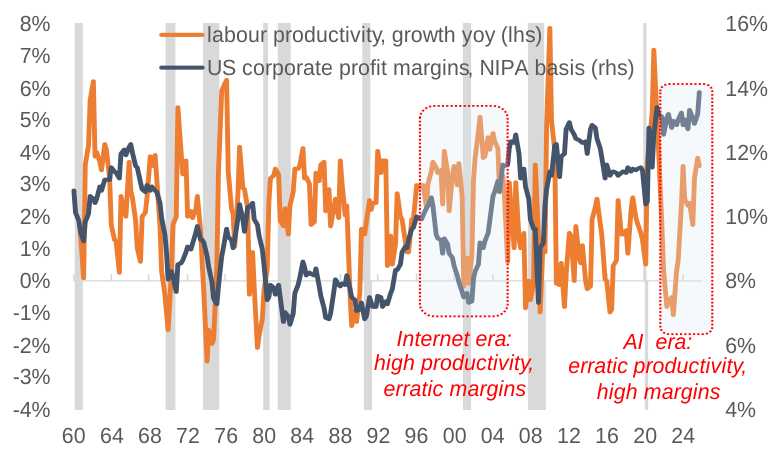
Productivity growth (chart D): an acceleration in growth of GDP per capita or output per hour worked.
US labour productivity has moved erratically over the past three years and is nearing the 4% clip posted around the TMT boom. It seems unlikely that this pace owes to economy-wide AI adoption, which still seems early-to-mid stage (chart A). As such, the data suggests the broad economic and profits benefits of AI adoption still lie ahead, though some benefit may already be visible.
Chart D
Productivity growth – Improving, but less consistently than in Internet eraUS labour productivity growth yoy (4Q mov. avg) versus corporate profit margins (NIPA basis). Grey bars indicate US recessions.
Source: AustralianSuper Investment Strategy, US BEA
-
4. Earnings growth and surprises
Earnings growth and surprises (charts E & F): an acceleration first in the innovation sector, then for the rest of the market.
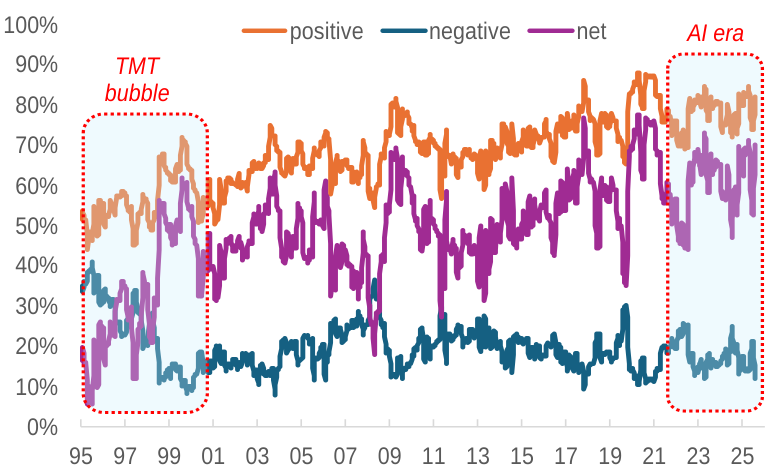
The acceleration in Tech earnings growth is as clear during the AI boom as it was during the TMT era. Earnings strength hasn’t broadened on a trailing basis as it did in the late 1990s (chart E), though forward estimates are doing so. The current US reporting season has been exceptionally strong, with about 80% of companies surpassing expectations and EPS growing at about 30% year-on-year. This run rate is about 20 percentage points higher than expected, which suggests that investor optimism has not become excessive (chart F).
Chart E
Earnings – Tech EPS growth still outpacing non-Tech by a wide margin12M trailing EPS growth for US Tech vs non-Tech sectors. Grey bars indicate US recessions.
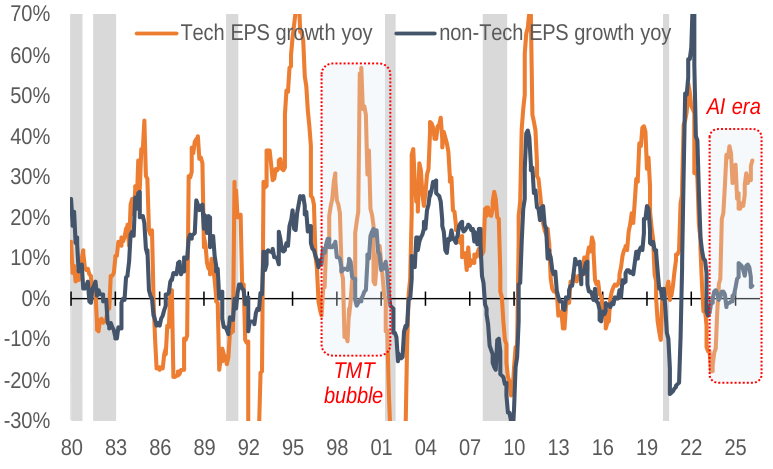
Chart F
Earnings surprises – Positive surprises persist, suggesting that expectations aren’t too highShare of S&P500 companies reporting positive and negative surprises each quarter, and net balance.
-
5. Valuations
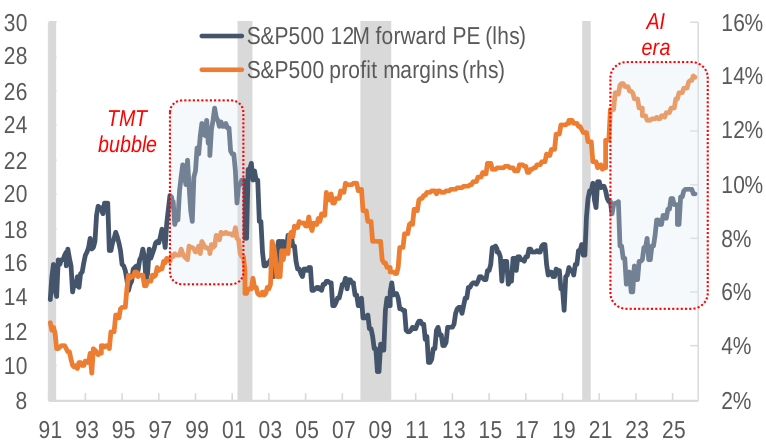
Valuations (chart G): a rise in earnings multiples, sometimes hyperbolically.
At 21x forward earnings (chart G), the S&P500 is about four turns less expensive as during the TMT bubble (peak multiple of 25x). Encouragingly, these expectations align with much higher profit margins now (14%) than during the Internet bubble (8%).
Chart G
Valuations – PE of 21x is well below TMT bubble of 25x, and backed by higher profit marginsS&P500 profit margins versus 12M forward PE ratio. Grey bars indicate US recessions.
Source: AustralianSuper Investment Strategy
-
6. Capital markets euphoria and leverage
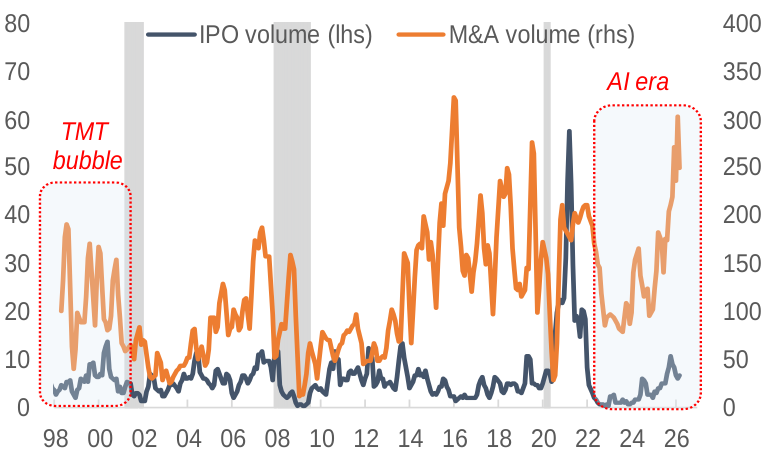
Capital markets euphoria and leverage (chart H): an outsized increase in capital markets activity/leverage to finance extraordinary capex.
Capital markets activity is accelerating towards dot-com levels or has surpassed those highs on several indicators, such as M&A volumes (chart H), Tech issuance as a share of both public and private markets debt issuance, and Venture Capital fundraising relative to PE Buyout fundraising. Although these measures are surging, aggregate debt-to-GDP ratios for US corporates and households continues to inch lower, meaning that balance sheets have not deteriorated during the AI boom. It is well documented that recessions are more likely, and more likely to be deep, when debt-financed asset bubbles burst, so aggregate figures provide balance to these considerations.
Chart H
M&A & IPO activity – M&A volumes are surging, but IPOs are well below bubble peaksUS M&A and IPO volumes in USD billions, 3-mo moving average. Grey bars indicate US recessions.
Source: Bloomberg, AustralianSuper Investment Strategy
-
7. Monetary policy
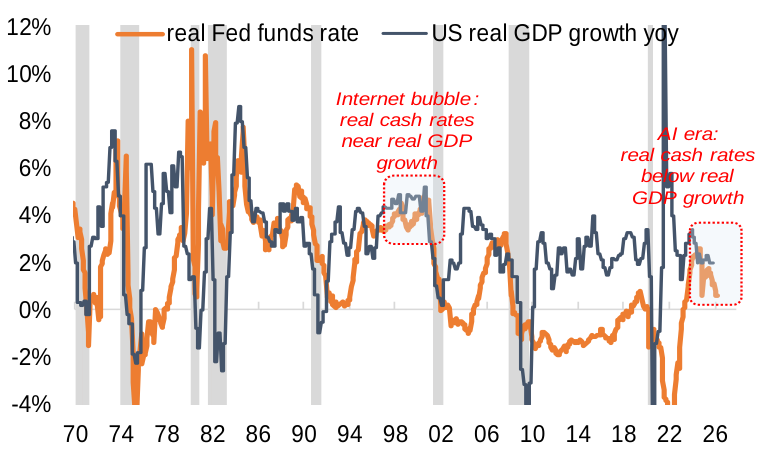
Macro/policy spoiler (chart I): a macro shock such as higher interest rates, which strains the imbalances (high leverage, high valuations).
The TMT bubble inflated as the Fed shifted to restrictive policy during the late 1990s, which contrasts with the Fed’s current neutral stance.
Chart I
Monetary policy – Real policy rates much looser (supportive) than during Internet bubbleReal Fed funds rate (nominal rate minus core PCE inflation) versus US real GDP growth.
Source: AustralianSuper Investment Strategy
Investment implications
Our listed equity portfolio has been further diversified across regions and sectors in 2025 and into 2026, reflecting the view the AI arc had some distance to run but that the winners may broaden from the more narrow set in the first phase of the arc.
At the asset-class level, we see limited evidence of an AI bubble, which we define as an environment of extraordinary valuations, return momentum, and leverage. We are mindful of this left-tail risk given the tendency of innovation waves to generate excess, since structural change is, by definition, challenging to price, and there will almost always be individual assets that exhibit such characteristics. For asset allocators, however, what matters are broad systemic risks, not narrow, security-level ones. As with past innovation cycles, the principal challenge is not predicting an end point, but managing exposure as the technology diffuses, and ensuring we deliver returns which are well sized relative to the risk over the long term.
For media enquiries, please contact:
Angus Livingston
E: alivingston@australiansuper.com
M: +61 438 012 162
Disclaimer
This material contains general information and commentary on market conditions and economic developments and does not constitute investment advice, an investment recommendation or investment research. The views expressed are based on information available at the date of publication and reflect current assumptions, expectations and opinions, which are subject to change without notice. While every care has been taken in the preparation of this material, no representations or warranties are given as to the accuracy or completeness of any statement in it, including without limitation, any forecasts. Statements regarding future matters are forward‑looking in nature and involve known and unknown risks and uncertainties. Such forward-looking statements are inherently uncertain and there are or may be important factors that could cause actual outcomes or results to differ materially from those indicated in such statements and accordingly reliance should not be placed on any forward-looking statement. Past performance is not necessarily a guide to future performance and outcomes and results may differ materially from those expressed or implied.
This material may include general financial advice which doesn’t take into account your personal objectives, financial situation or needs. Before making a decision consider if the information is right for you and read the relevant Product Disclosure Statement, available at australiansuper.com/PDS or by calling 1300 300 273. A Target Market Determination (TMD) is a document that outlines the target market a product has been designed for. Find the TMDs at australiansuper.com/TMD.
AustralianSuper Pty Ltd ABN 94 006 457 987, AFSL 233788, Trustee of AustralianSuper ABN 65 714 394 898.